
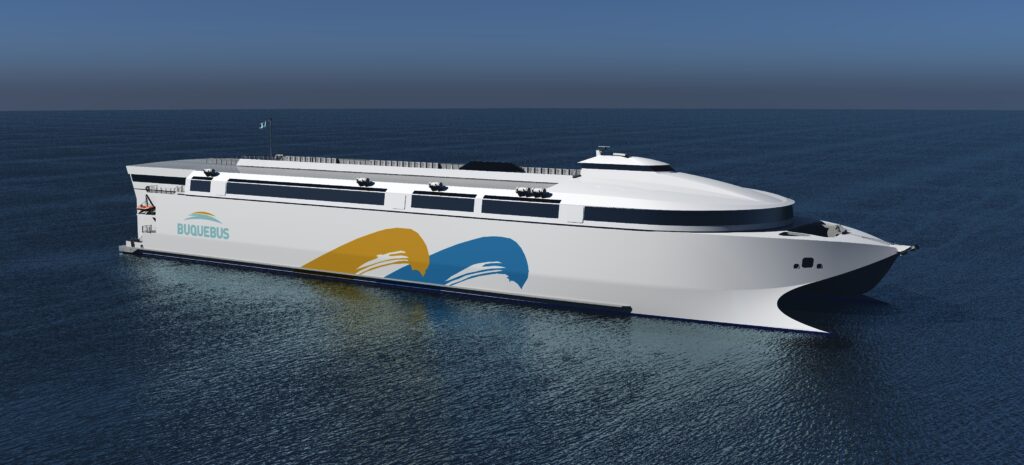

Hobart-based Incat has completed the rollback and the placement of the superstructures on Hull 096, the fully electric ferry ordered by Argentina’s Buquebus.
Rollback is the procedure to place the hull at the end of the construction hall, from where it will be subsequently launched. Moreover, the placement of the superstructures marks the end of the bulk of structural work and the beginning of final, shipboard outfitting.
“The industry will be blown away”
Incat CEO Stephen Casey commented, “Now that most of the structural work is complete, it allows our fit-out crews to begin their work on the interior of the vessel, this is a really exciting time in the build process.” Mr. Casey has previously said that “the industry will be blown away when it hits the water”. This is expected by June 2025.
Incat Chairman Robert Clifford added, “At 130 meters long, this is the largest vessel we have ever rolled back, and our crews did an exceptional job.”
From LNG to fully electric
Hull 096 will take more than 6 years to build. It was first ordered by Buquebus as “the world’s largest aluminium ship” in May 2019. The fast ferry would join the South American operator’s fleet at the Rio de la Plata estuary connecting Argentina and Uruguay.
The Tasmanian shipyard has delivered eight other fast ferries to Buquebus and its affiliates. The last one was the 99-meter Hull 069, later named Francisco in honor of the Argentinian pope. It was built in 2013 and is powered by dual-fuel LNG marine gas turbines by GE.
As its predecessor, Hull 096 would originally be powered by LNG-fueled gas turbines, but fitted in a much larger hull with approximately twice the capacity. While the Francisco can fit 1,000 passengers plus around 140 cars, Hull 096 will carry 2,100 passengers and 226 vehicles.
After a period of delays and hibernation for undisclosed reasons, Incat and Buquebus announced in early 2023 that the design of the unfinished ferry would change dramatically. It would be fully electric instead and “the largest, lightweight, zero emissions ferry operating on any route in the world.” Mr. Clifford even stated that, counterintuitively, the propulsion change made the vessel lighter.
The energy storage system (ESS), at over 40MWh, will be four times larger than any similar installation for marine applications. The electrical system integration is by Wärtsilä and the ESS is by Corvus Energy.
The string of decisions by Buquebus is part of the dawn of the maritime energy transition in Latin America and marked a textbook example of how LNG can be a transitional fuel between legacy and zero-emission propulsion. It also tested the limits for applying battery electric technology to larger fast ferry crossings, which up to that point was mostly confined to slower and shorter crossings, mostly in Norway.
“Option to convert”
Later in 2023, Incat developed a smaller, 70-meter electric fast ferry that it intends to build as a high-volume standardized series to enable the decarbonization of the ferry industry. An electric-hybrid version has been picked up for a “design study” with DFDS in April 2024. The Danish operator is not going all-in on fully electric designs for now, but retains the “option to convert to fully electric” in the future. Thankfully to DFDS, Incat is not a church, where an “option to convert” would likely not be enough to be baptized.
Zero emission crossings in 2026
As construction of Hull 096 surpassed 50% in March of 2024 and after the rollback was finalized in late May, Incat asserts that the revised timeline is “firmly on schedule”. According to Tom Cooper, Media and Communications Manager, “delivery is expected to be towards the end of 2025 – most likely around November”, making the ferry available to commence operations in South America by early 2026.
 Maritime South