


Brazilian agricultural conglomerate Amaggi, which also operates an extensive inland shipping business in the country’s Amazon River basin, has completed a trial voyage using 100% biodiesel as fuel. The journey started on 11 May 2024 and lasted approximately 220 running hours (9 days).
The 100% biofuel bunker is also known as B100.
Brazil has a biodiesel mandate for land transportation, with a current 14% (B14) blending requirement in diesel fuel. In 2025, it will increase to 15% (B15). Amaggi’s long-haul B100 trials started with road transport, leading up to the company ordering 100 agricultural trucks fueled by B100 in November 2023. The firm’s owned truck fleet comprises 700 trucks and is expected to close 2024 at 1,100 units.
However, the marine diesel oil (MDO) used in shipping is biofuel-free due to current technical and regulatory restrictions. In Brazil, a series of trials hope to change that, led by Petrobras (B10 and B24) and Bunker One (B7). Internationally, B100 has been recently trialed by Norwegian ferry company Color Line in the Baltic, Danish shipping company Norden in Singapore and is already in commercial operations at Canadian dry bulk operator CSL.
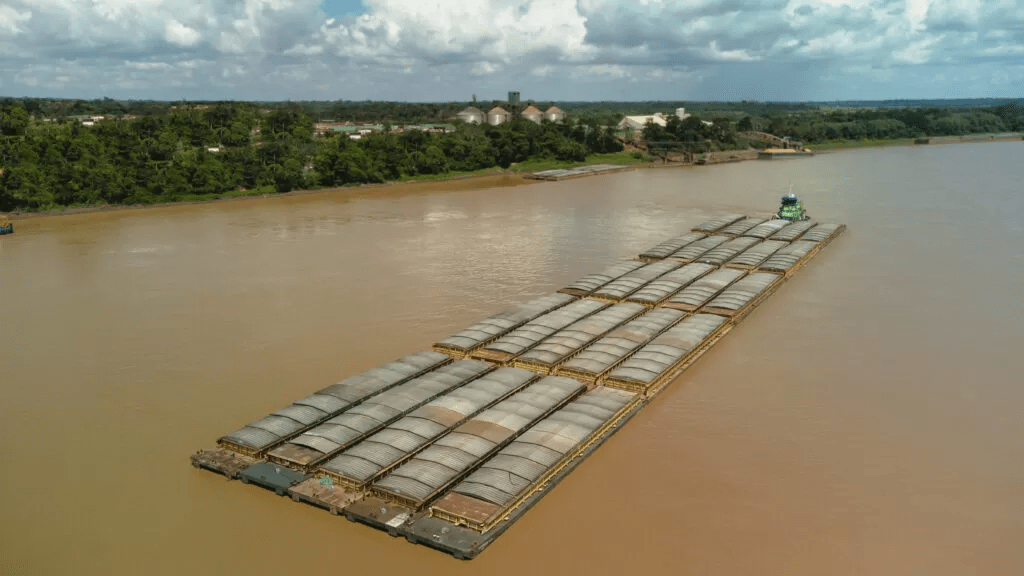
Amaggi was granted the go-ahead for the inland shipping trials by the Brazilian National Agency for Petroleum, Natural Gas and Biofuels (ANP) in April this year. The voyage started in the Portochuelo terminal located in Porto Velho with a 25-barge, 50,000 ton convoy. The roundtrip down the Madeira River to Itacoatiara is around 2,000 km long.
The Cuiabá-based firm has the advantage of being vertically integrated. It produces the biodiesel itself in Lucas do Rio Verde, thus being less sensitive to price fluctuations. It grows or trades most of the cargo it ships (mainly corn and soy). It also owns or co-owns a substantial inland shipping fleet (pushboats and dry bulk barges) and the connecting terminals on the Madeira, Amazonas and Tapajós rivers. The inland shipping trials are in fact part of a much larger rollout of biodiesel along its operations, aiming at a low-carbon grain value chain. It includes the biodiesel plant and the trucks, as well as tractors and other farming equipment, in what was dubbed the “B100 farm“.
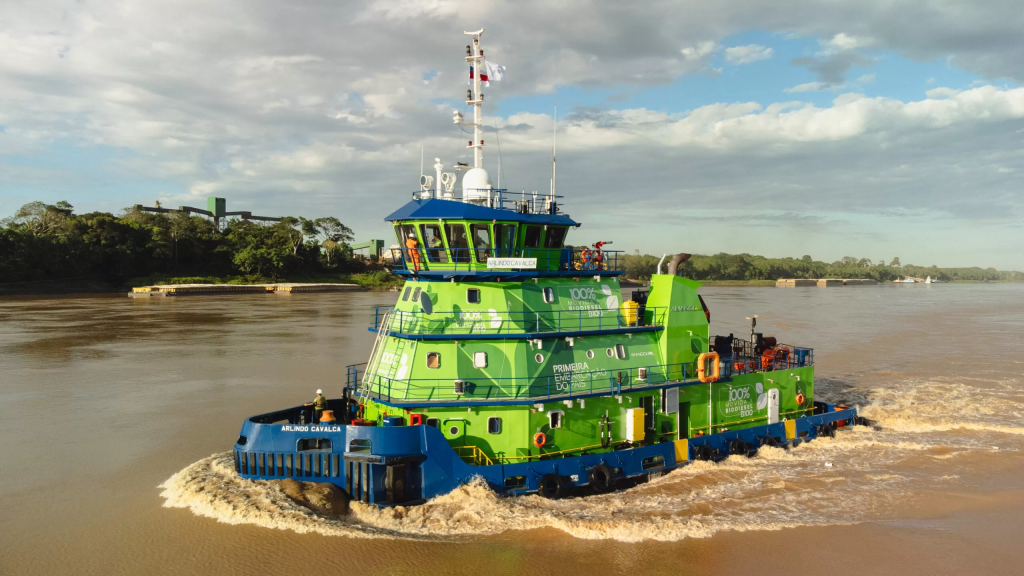
Amaggi is, therefore, well-positioned to perform such a B100 inland shipping trial. And perform it did, with a flamboyant paint job on the pusher’s superstructure tailored to the occasion. One can read “first vessel in the country 100% powered by biodiesel B100” all over it.
The pusher is the Robert Allan Ltd.-designed Arlindo Cavalca, built in 2017 by the defunct Erin Shipyard of Manaus.
Cícero Ferreira, operations manager at the Madeira-Amazonas corridor, commented that the biodiesel was produced by Amaggi’s new Lucas do Rio Verde plant, which began operations in 2023. He added that “this is another great step by Amaggi, proving its commitment to sustainability. One hopes that with this [fuel] switch, we’ll be able to lower greenhouse gases [emissions] by more than 90%”.
Matheus Nunes, inland shipping fleet manager, added that Amaggi was able to perform the trial with “few modifications”. The firm hopes the subsequent data analysis, including safety performance and fuel consumption parameters, will help it reach its decarbonization targets.
Amaggi has not disclosed plans for commercial B100 shipping operations yet or if such plans would have any effect on pricing, as biodiesel is more expensive than MDO.
What is clear, however, is that biodiesel is now one of the core elements of the company’s decarbonization strategy.
A summary video of the voyage can be seen below (in Portuguese).
 Maritime South